Before Your Team Uses AI Everywhere, Put These Simple Rules in Place
If your small business is already using ChatGPT, Claude, Gemini, Perplexity, Canva AI, Microsoft Copilot, Notion AI, or automation tools like Zapier and Make, you need an AI governance policy before usage becomes messy.
This guide is part of our AI Automation for Small Business series.
Not an enterprise-sized compliance manual. Not a 40-page legal framework. Just a clear, practical set of rules that tells your team what they can use AI for, what data they must never enter into AI tools, who reviews AI-generated work, and how the business protects clients, customers, and confidential information.
This guide gives you a plain-English AI governance policy template designed for small businesses, agencies, consultants, freelancers, and lean teams in 2026. You can adapt it in under an hour and use it as the foundation for safer, more consistent AI adoption.
Important note: This article is educational and not legal advice. If you handle regulated data, operate in healthcare, finance, legal services, education, insurance, government contracting, or serve EU/UK customers, consult a qualified legal or compliance professional before finalizing your policy.
Why Small Businesses Need AI Rules Before Problems Appear
AI adoption usually starts innocently. Someone uses ChatGPT to rewrite an email. A marketer uses an AI writing tool to draft ad copy. A project manager summarizes client notes. A freelancer uses AI to speed up proposals. Then, within a few months, AI tools are quietly embedded across the business.
The problem is not AI usage itself. The problem is unmanaged AI usage.
Without simple rules, your team may accidentally paste confidential client information into public AI tools, rely on inaccurate outputs, publish AI-generated content without review, expose personal data, or build workflows around tools that later become expensive, restricted, or unavailable.
For small teams, the stakes are real. One privacy mistake can damage client trust. One inaccurate AI-generated recommendation can create reputational risk. One poorly governed workflow can become difficult to unwind later. As many AI implementation specialists now emphasize, governance is much easier to define early than retrofit after tools are already embedded in daily operations.
The good news: small business AI governance does not need to be complicated. You need practical operating rules, not enterprise bureaucracy.
What AI Governance Means in Plain English
AI governance means deciding how your business uses AI responsibly, safely, and consistently.
For a small business, an AI governance policy should answer six basic questions:
- Which AI tools are approved for use?
- What tasks can employees use AI for?
- What data is never allowed inside AI tools?
- Which AI outputs require human review?
- How should AI be disclosed to clients or customers?
- Who is responsible for training, updates, access, and oversight?
That is the practical core of AI compliance for small business. You are not trying to eliminate every possible risk. You are creating sensible guardrails so your team can benefit from AI without guessing what is allowed.
Frameworks such as the NIST AI Risk Management Framework, ISO/IEC 42001, GDPR guidance, and privacy regulator recommendations can be useful references. But most small companies do not need to start with enterprise-level documentation. Start with a one-page policy. Then expand only when your risks, clients, or legal obligations require it.
The Main AI Risks Small Businesses Should Manage
Before writing your policy, it helps to understand the risks you are actually trying to reduce.
| Risk Area | What Can Go Wrong | Practical Policy Rule |
|---|---|---|
| Data privacy | Employees paste personal, customer, or client data into AI tools without approval. | Define restricted data and ban it from unapproved tools. |
| Client confidentiality | Client strategies, contracts, financials, or internal notes are exposed to third-party platforms. | Require anonymization or written client approval before using client data. |
| Accuracy and quality | AI outputs contain errors, outdated facts, fake citations, or misleading recommendations. | Require human review before anything is sent, published, or relied upon. |
| Compliance | AI usage conflicts with GDPR, contractual duties, industry rules, or customer expectations. | Classify high-risk use cases and require manager approval. |
| Security | Unapproved AI browser extensions or integrations gain access to documents, email, or customer records. | Approve tools centrally and control access permissions. |
| Vendor lock-in | The business builds key workflows around one AI vendor that becomes expensive, changes terms, or disappears. | Document workflows, keep exports, and avoid relying on a single tool for critical operations. |
These risks are especially relevant for agencies, consultants, freelancers, and service businesses handling client data. Search interest around data privacy AI small business, GDPR AI tools small business, and vendor lock-in AI 2026 reflects a real concern: teams want the productivity gains of AI without creating avoidable compliance or trust issues.
The One-Page AI Governance Policy Framework
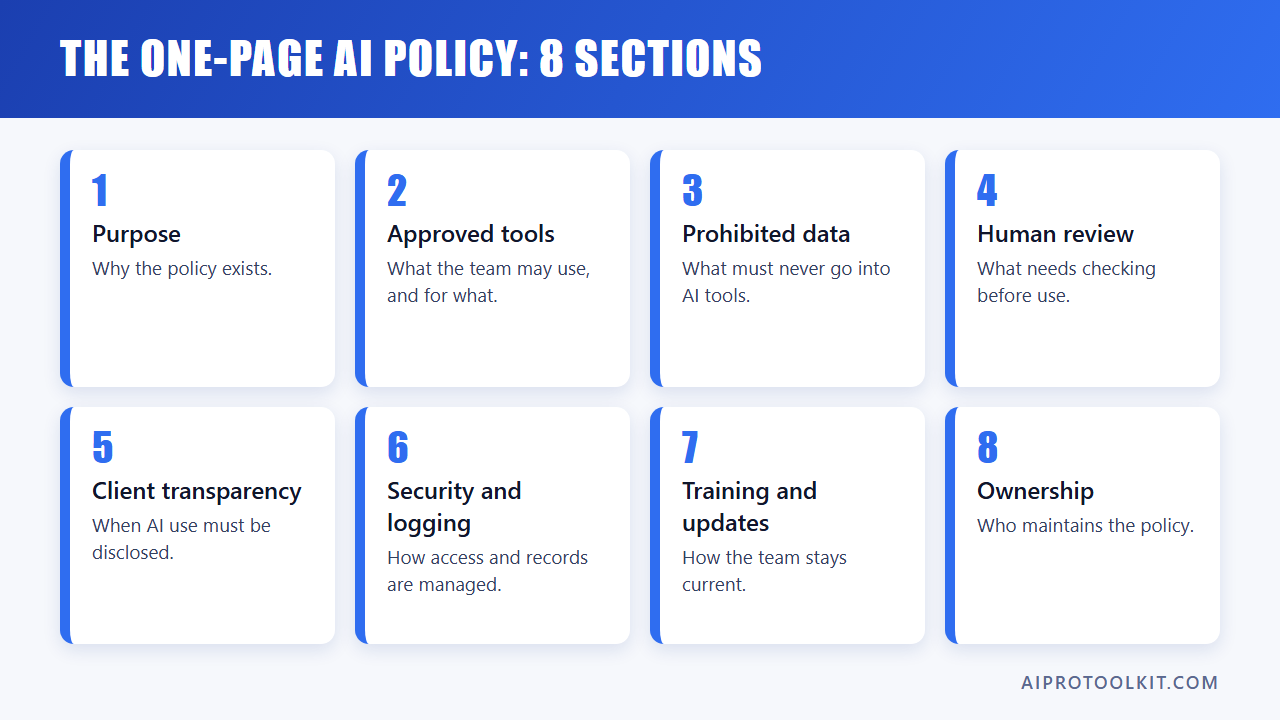
A good small business AI policy should be short enough that people actually read it. The best version is usually one page, supported by a tool register and occasional training notes.
Use this structure:
- Purpose: Why the policy exists.
- Approved tools and use cases: What employees may use.
- Prohibited data: What must never be entered into AI tools.
- Human review: What requires checking before use.
- Client transparency: When AI use must be disclosed.
- Security and audit logging: How access and records are managed.
- Training and updates: How employees stay current.
- Ownership: Who maintains the policy.
This framework is deliberately simple. A five-person team does not need the same governance structure as a multinational bank. But it does need clear rules that prevent accidental misuse.
Section 1: Approved AI Tools and Use Cases
Your policy should clearly state which AI tools are approved. This prevents employees from connecting random apps to sensitive business systems just because a tool looks useful on social media.
Start by creating an AI tool register. It can be a spreadsheet with the following columns:
| Tool | Approved Use | Data Allowed | Owner | Review Date |
|---|---|---|---|---|
| ChatGPT Team | Drafting, brainstorming, summarizing non-sensitive material | Public, internal non-confidential, anonymized examples | Operations Lead | Quarterly |
| Claude | Document analysis, first-draft writing, policy review | Anonymized or approved internal documents | Founder | Quarterly |
| Perplexity | Research support and source discovery | Public information only | Marketing Lead | Quarterly |
| Canva AI | Design drafts and marketing visuals | Approved brand assets only | Creative Lead | Quarterly |
It’s common advice among enterprise software vendors to conduct an internal audit before signing up for any AI trial. That advice applies to small businesses too. Before buying another tool, ask:
- What problem does this tool solve?
- Who will use it?
- What data will it access?
- Does it store prompts, uploads, or outputs?
- Can we export our data if we leave?
- Does the vendor provide security, privacy, and data processing information?
A £5,000 tool without training and adoption can underperform a £500 tool that your team uses well. The goal is not to chase novelty. The goal is practical AI that produces real results.
Section 2: Data That Is Never Allowed in AI Tools
This is the most important part of your AI governance policy template. Your team should know exactly what they must not paste into public or unapproved AI systems.
For most small businesses, the following data should be restricted unless the tool is approved, the use case is authorized, and appropriate privacy protections are in place:
- Client names connected to confidential projects
- Customer personal data, including email addresses, phone numbers, home addresses, and account details
- Payment information, financial records, tax information, or bank details
- Health, legal, insurance, HR, or employment records
- Login credentials, API keys, passwords, tokens, or private URLs
- Confidential contracts, proposals, pricing models, or negotiation details
- Unreleased product plans, source code, trade secrets, or proprietary processes
- Data covered by NDAs, client agreements, GDPR, HIPAA, SOC 2 commitments, or similar obligations
So, can employees use ChatGPT with client data? The safest answer for most small businesses is: not unless the data is anonymized, the tool is approved for that data type, and the client contract or privacy obligations allow it.
For example, instead of pasting this:
“Write a response to Acme Dental about their unpaid invoice for £12,850 and mention that Sarah Johnson disputed the implant billing.”
Use this:
“Draft a polite payment follow-up email to a client regarding an overdue invoice. Do not include names, amounts, medical details, or confidential information. Keep the tone professional.”
This simple habit can reduce a large portion of data privacy risk.
Section 3: Human Review Requirements
AI can draft quickly, but it does not replace judgment. Your policy should define what must be reviewed before it is used.
Require human review for any AI-generated output that is:
- Sent to clients, customers, partners, regulators, or suppliers
- Published on your website, blog, newsletter, ads, or social channels
- Used for legal, financial, medical, HR, safety, or compliance decisions
- Used to make recommendations about a person, customer, or employee
- Used in code, automation workflows, or data processing systems
- Based on research, statistics, citations, or factual claims
- Used to represent your brand, pricing, service promises, or professional advice
Human review should check:
- Accuracy: Are the facts correct?
- Context: Does the output match the situation?
- Confidentiality: Does it reveal anything sensitive?
- Bias and fairness: Could it unfairly affect someone?
- Brand voice: Does it sound like your business?
- Legal and contractual fit: Does it comply with obligations?
This is especially important for marketing teams. A large share of marketing work involves draft content creation, making content workflows a common AI pilot area. AI can help create first drafts, outlines, briefs, headlines, and variations, but final approval should stay with a trained person.
Section 4: Client Work, Attribution, and Transparency
If you are an agency, freelancer, consultant, or professional services provider, AI governance must cover client work.
Your policy should answer:
- Can AI be used to produce client deliverables?
- Can client data be used in AI tools?
- Must clients be told when AI contributes to work?
- Who owns the final output?
- Who is responsible for fact-checking and quality?
In many cases, you do not need to disclose every internal use of AI, such as brainstorming or grammar improvement. But you should consider disclosure when AI materially contributes to deliverables, when client data is involved, or when your contract requires transparency.
A practical client transparency clause might say:
“We may use approved AI tools to support research, drafting, ideation, analysis, and workflow efficiency. We do not enter confidential client data into public AI tools without authorization. All client-facing deliverables are reviewed by a human before delivery.”
This kind of statement builds trust without overcomplicating the relationship.
Section 5: Security, Audit Logs, and Access Control
Security is where many small teams become vulnerable. AI tools often request access to Google Drive, Slack, email, CRMs, Notion, project management software, or customer databases. One careless integration can expose more data than intended.
Your policy should include basic rules for security and AI audit logging:
- Only approved team members may connect AI tools to business systems.
- Employees must not install AI browser extensions that access email, documents, or customer systems without approval.
- Admin accounts must use strong passwords and multi-factor authentication.
- AI tool access should be removed when employees, freelancers, or contractors leave.
- High-risk AI use cases should be logged, including tool used, purpose, data type, reviewer, and date.
- Critical AI-generated decisions must be traceable to a human reviewer.
You do not need a complex enterprise logging system to begin. A spreadsheet or project management board can work for a small team. The point is to create accountability.
For example, if AI is used to summarize customer feedback before a product decision, log the tool, dataset, prompt category, reviewer, and final decision. If AI is used to draft a legal notice, financial communication, or HR document, log the review and approval process.
Section 6: Training and Update Schedule
Buying AI software is not the same as adopting AI effectively. Many failed AI projects are not tool failures. They are training failures.
AI training for employees should cover:
- What the company’s approved AI tools are
- What data employees can and cannot use
- How to write safe prompts
- How to check AI outputs for accuracy
- How to spot hallucinations, bias, and unsupported claims
- When to ask for manager approval
- How to report mistakes or concerns
Keep training lightweight but consistent. A 45-minute onboarding session, a one-page policy, and quarterly refreshers are enough for many small teams.
Your policy should be reviewed at least every six months, or sooner if:
- You adopt a new AI tool
- You begin using AI with client or customer data
- A vendor changes its privacy terms
- You enter a regulated market
- A client requests AI-related assurances
- A mistake, complaint, or security issue occurs
Workflow consistency matters more than isolated automation. If one employee uses AI safely and another uses it carelessly, your business still has risk. Governance and training turn individual experimentation into reliable operating practice.
AI Governance Policy Template for Small Businesses
Use the following template as a starting point. Customize it to your business, tools, clients, contracts, and legal obligations.
Small Business AI Usage Policy
Purpose: This policy explains how our team may use artificial intelligence tools safely, responsibly, and consistently. AI may be used to improve productivity, drafting, research, analysis, automation, and internal workflows, but it must not compromise confidentiality, privacy, quality, security, or client trust.
Approved Tools: Employees may only use AI tools listed in our approved AI tool register for business work. New AI tools, browser extensions, integrations, or automation platforms must be approved by [Policy Owner] before use.
Approved Use Cases: AI may be used for brainstorming, outlines, first drafts, summarization of approved content, research support, internal productivity, process documentation, coding assistance, and marketing drafts, provided this policy is followed.
Prohibited Data: Employees must not enter confidential client information, personal data, financial records, health information, legal records, passwords, API keys, trade secrets, unreleased business plans, proprietary code, or data covered by contracts, NDAs, GDPR, SOC 2 commitments, or other legal obligations into unapproved AI tools.
Client Data: Client data may only be used in AI tools when authorized, necessary, and approved. Where possible, data must be anonymized or generalized before being entered into an AI system. Employees must follow client contracts and privacy requirements at all times.
Human Review: AI-generated outputs must be reviewed by a qualified human before being sent externally, published, used in client work, relied upon for business decisions, or used in legal, financial, HR, medical, security, or compliance-related contexts.
Accuracy: Employees are responsible for checking AI outputs. AI-generated facts, statistics, citations, recommendations, calculations, and claims must be verified using reliable sources before use.
Transparency: We will be transparent about AI use when required by law, contract, client expectation, or professional judgment. AI must not be presented as a substitute for licensed professional advice where human expertise is required.
Security: Employees must not connect AI tools to company systems, email, cloud storage, CRMs, customer databases, code repositories, or communication platforms without approval. Multi-factor authentication must be used where available.
Audit Logging: High-risk AI use cases must be logged, including the tool used, purpose, data type, reviewer, approval status, and date. The policy owner may review logs to improve safety and consistency.
Training: All employees, contractors, and freelancers using AI for business work must complete basic AI usage training and review this policy. Questions should be directed to [Policy Owner].
Review Schedule: This policy will be reviewed every six months or sooner if we adopt new AI tools, handle new data types, receive client requests, experience an AI-related issue, or face new legal or compliance requirements.
Policy Owner: [Name / Role] is responsible for maintaining this policy, approving tools, coordinating training, and reviewing AI-related risks.
Common AI Governance Mistakes to Avoid
Most small business AI mistakes are predictable. Avoid these from the start.
1. Letting Everyone Choose Their Own Tools
Experimentation is useful, but unmanaged tool usage creates security and privacy risk. Maintain a short approved tool list.
2. Treating AI Outputs as Finished Work
AI is excellent for drafts, summaries, and idea generation. It can also invent facts, misunderstand context, and produce confident errors. Human review is non-negotiable.
3. Ignoring Client Contracts
If your contract says client information must remain confidential, do not assume AI usage is acceptable. Check terms before using client data.
4. Skipping Employee Training
A policy nobody understands will not protect your business. Train your team with real examples from their daily work.
5. Forgetting About Vendor Lock-In
In 2026, AI tools will continue changing quickly. Some will raise prices, remove features, alter data policies, or disappear. Document important workflows and avoid making critical operations dependent on one vendor without an exit plan.
6. Making the Policy Too Complicated
If your AI policy reads like enterprise compliance documentation, your team may ignore it. Keep the first version short, practical, and easy to apply.
Quick Implementation Plan: Create Your AI Policy This Week
If you want to move quickly, follow this five-step plan.
- Audit current AI usage: Ask your team which AI tools they use, for what tasks, and with what data.
- Create an approved tool list: Keep only tools with a clear business purpose and acceptable privacy posture.
- Define restricted data: List what must never be entered into public or unapproved AI tools.
- Set review rules: Decide which outputs need human approval before use.
- Train the team: Walk through examples and update the policy every six months.
Start small. Measure quality. Expand only after your team proves the workflow is useful, safe, and repeatable.
FAQ: AI Governance Policy Template for Small Businesses
How do I create an AI policy for a small team?
Start with a one-page policy that defines approved AI tools, allowed use cases, prohibited data, human review requirements, client transparency rules, security controls, training expectations, and a review schedule. Keep it practical and update it as your AI usage grows.
What should a small business AI governance policy include?
It should include the policy purpose, approved tools, permitted tasks, restricted data, rules for client information, human approval requirements, audit logging for high-risk use cases, access control, employee training, and ownership of the policy.
Can employees use ChatGPT with client data?
Employees should not enter confidential client data into ChatGPT or any AI tool unless the tool is approved for that data type, the data use is allowed by contract and privacy law, and the business has appropriate protections in place. In most cases, anonymizing or generalizing the information is safer.
What AI activities require human review?
Human review should be required for anything sent externally, published publicly, delivered to clients, used for business decisions, or related to legal, financial, HR, medical, security, compliance, or customer-impacting matters.
How often should an AI policy be updated?
Review your AI policy at least every six months. Update it sooner when you adopt new tools, process new types of data, change client services, enter regulated markets, or experience an AI-related issue.
Do small businesses need AI audit logging?
Yes, but it can be simple. For high-risk AI use, record the tool used, purpose, data type, human reviewer, approval status, and date. A spreadsheet is often enough for a small team.
How does GDPR affect AI tools for small businesses?
If your business handles personal data from the EU or UK, GDPR may apply. You need to understand what personal data is being processed, why it is processed, where it is stored, whether vendors act as processors, and whether your AI usage matches your privacy notices and legal obligations. Get legal advice for sensitive or regulated processing.
Choosing an AI Governance Policy Template Small Business Owners Can Actually Use
Not every template you find online will fit a lean team. Many are written for enterprises with dedicated legal and compliance departments, which makes them long, jargon-heavy, and hard to apply. When you are evaluating an AI governance policy template small business owners can realistically roll out in a week, look for three things: it fits on one or two pages, it names specific tools and specific prohibited data rather than vague principles, and it has a clear owner who is accountable for keeping it current.
If your business is still deciding which processes to automate before locking in tool choices and policy language, AIProToolkit’s guide on AI for business automation is a useful companion piece, since governance decisions tend to go smoother once you already know which workflows AI will actually touch.
Conclusion: AI Governance Is Not Bureaucracy; It Is Good Business
AI can help small businesses move faster, create better drafts, automate repetitive work, improve research, and serve clients more efficiently. But speed without rules creates risk.
A simple AI governance policy gives your team confidence. It tells employees what is allowed, protects client and customer data, improves output quality, supports compliance, and reduces the chance of expensive mistakes. Most importantly, it turns AI from scattered experimentation into a reliable business capability.
You do not need to wait until your company is larger. In fact, the best time to set AI rules is before AI becomes embedded everywhere.
Next step: Download AIProToolkit’s One-Page AI Governance Policy Template and customize it for your team before rolling out more AI tools. Practical AI works best when your people, processes, and safeguards grow together.